· AI · 5 min read
Case Study: weKnow Inc as a Business Incubator
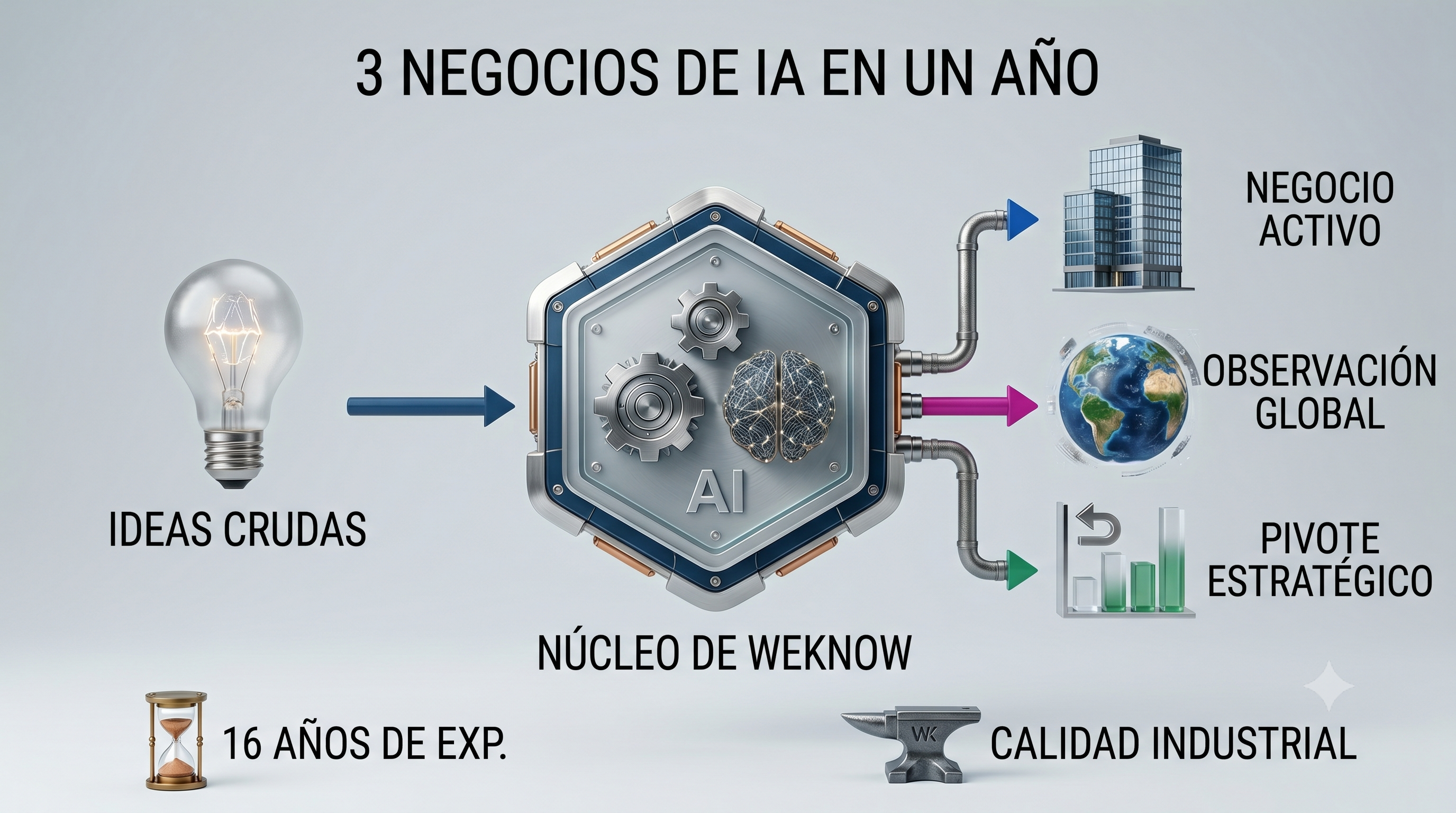
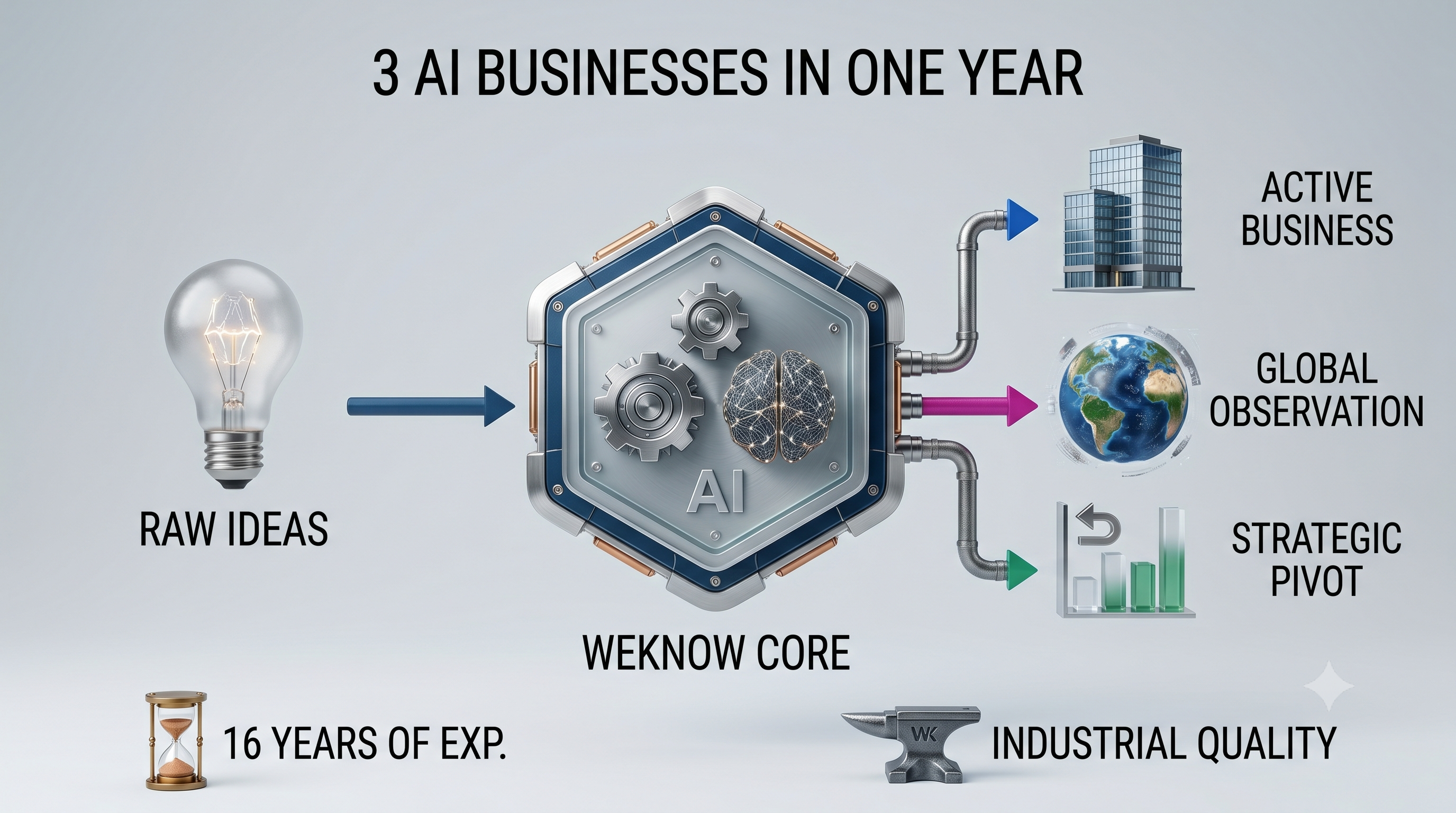
People have "Vibe Coding." Companies have side projects. Here is how weKnow Inc turned three complex AI products into real businesses in under a year.
We live in an era where social media is flooded with people doing “Vibe Coding”: generating toy apps that do nothing real or games nobody wants to play, blindly trusting AI to write all the code.
At weKnow Inc, we distance ourselves from that bubble. We prove that 16 years of software development experience is the differential factor. AI is not magic; it is an industrial-strength tool that requires engineers and architects who know how to wield it.
In the last year, we have acted as our own business incubator, leveraging our expertise to accelerate the development of three complex projects in less than one year. These are not demos; they are robust architectures. Two of them are already operational businesses in Costa Rica, Panama, and Spain, currently in monetization with real users.
Below is the technical and business breakdown of our methodology.
Project #1: BigEstia (The “Fail Fast” Validation)
Concept: BI (Business Intelligence) + Management + AI.
Status: Incubated, launched, discontinued (strategic pivot).
This project was born to solve a real corporate problem: the “Blank Page Syndrome.” Companies were buying ChatGPT licenses for their employees expecting a magical productivity boost. The reality was employees paralyzed in front of a blinking cursor, not knowing what prompt to write.
- The Engineering Solution: Instead of an open chat, we developed a platform with 16 Solution Funnels.
- The system eliminated the need to “know how to ask.” It knew beforehand what strategic questions to ask the user for each task (from drafting a delicate email to analyzing a legal document).
- Internal Processing: User responses were processed by a chain of hidden prompts and business logic to generate a polished final deliverable.
- The Outcome: It was an engineering and rapid deployment success. However, after three months of development, launch, and promotion, we detected that market traction was not as expected.
- The Incubator Lesson: Thanks to our agility, we didn’t waste years or fortunes. We applied the Fail Fast philosophy, closed the project, and redirected the resources and technical learning to the next side project.
Project #2: Propiedades.cr (PropTech)
Concept: Comprehensive real estate portal with hybrid search.
Location: Costa Rica (propiedades.cr) and Panama (propiedades.pa) — active businesses.
Here we didn’t just integrate AI; we built a complete digital business from scratch. We developed the scrapers for property acquisition, the listing system, and an AI-optimized SEO strategy that today generates tens of thousands of monthly visits and thousands of recurring users.
1. The Data Engineering Challenge (From 23% to 96%)
The problem with real estate is data “messiness”: duplicate condo names, ambiguous addresses, and non-existent hierarchies.
- Implementation: We didn’t use AI to “guess.” We created a training and cleaning pipeline.
- Evolution: In the first iteration, classification effectiveness was barely 23%. We didn’t stop. Through a month and a half of iterations—refining inputs, combining logical rules, and providing correct hierarchies—we achieved a 96% effectiveness rate in AI data classification.
- Quality Control: We programmed the AI to provide its own “certainty percentage.” If the certainty is not high, the system routes that data for manual review. We automated 96% of the grunt work.
2. Hybrid Search Architecture (Security & Speed)
Last but not least, we built an in-house AI-powered search: fast, cost-effective, and without sharing user data with any third-party LLM.
We rejected the idea of a rigid “SQL search” or letting an LLM hallucinate results.
- The Firewall: The AI never touches the database. This is critical for security and cost.
- Technical Flow:
- The user says: “I’m looking for a rental under $500 and I have a chihuahua.”
- The AI detects intents: Price < 500, Pet_Friendly = True.
- These intents are translated into intermediate commands for Elasticsearch.
- We use Elasticsearch advanced queries (fuzzy search) to execute the actual retrieval.
- Performance: While million-dollar competitors like Redfin take up to 40 seconds for complex queries, our hybrid architecture responds in 2 to 3 seconds.
Project #3: Neométrico (Earth Observation)
Concept: Democratization of satellite data (Copernicus/NASA/USGS/Others).
Location: Spain (consolidating and monetizing).
This is our most complex project. The goal of Neométrico is to let anyone monitor climate change without needing to hire a PhD.
1. Data Science vs. AI (The Vital Distinction)
It is crucial to understand this: the analysis is not done by AI. We use pure data science algorithms and physics to process the terabytes of raw data sent by satellites regarding methane, CO2, and temperature. AI does not calculate; AI communicates.
2. Agent GAIA: “Don’t Patronize the User”
AI is used for the accessibility layer. We generate non-academic reports that translate hard science into human language.
- Chat with GAIA: If the report isn’t enough, the user can chat with GAIA.
- Logical Explainability: GAIA doesn’t just answer doubts; it explains the input, the output, and the logic applied in the report.
- Philosophy: It’s like having a senior team of environmental scientists by your side. GAIA explains complex concepts (like methane saturation) conversationally without judging you for not knowing, empowering the user to present these reports to superiors or authorities with total confidence.
Conclusion
People have “Vibe Coding” and pretty demos. weKnow Inc has the engineering capacity to turn side projects into real, secure, and scalable companies.
We have the architecture, the 16 years of experience, and the business vision. If you have an idea, stop treating it like a hobby. Contact us, and let’s make it a reality.